
Latin American Spanish vs Spain Spanish: What's the Difference?
Okay, so one of my students asked me this last week during our lesson: "Gaby, am I learning the right Spanish? Because I watched a show from Spain and I couldn't understand half of what they were saying!"
And honestly? That's such a common thing to feel. So let me clear this up once and for all, because I think it'll make you feel a lot better about your progress.
First things first: it's still the same language
Think of it like American English vs British English. Same language, totally understandable to each other, but with some differences that can definitely throw you off at first. That's exactly what's going on with Latin American Spanish and Spain Spanish.
Nobody is speaking "wrong" — they're just speaking differently. And once you know what those differences are, they stop being confusing and start being actually pretty fascinating.
1. The pronunciation thing (yes, the "lisp")
This is usually what surprises people the most. In Spain, the letters c (before e or i) and z are pronounced like the "th" in think. So if you hear a Spaniard say Barcelona, it sounds like "Bar-the-lona." And gracias becomes "gra-thee-as."
In Latin America? We pronounce those letters as a regular "s." So gracias is just "gra-see-as." Simple, clean, easy.
Neither one is wrong — it's just a regional thing that developed over centuries. But I'll be honest with you: most of my students find the Latin American pronunciation more natural to learn at first. And since all of our tutors at Spanish Now are from Latin America, that's what we teach!
2. Some words are just... different
This is the fun part. The same everyday object can have a completely different name depending on where you are. Here are some of my favorites:
English Latin America Spain
Car Carro Coche
Apartment Apartamento Piso
Computer Computadora Ordenador
Juice Jugo Zumo
So if you're learning Spanish to travel through Mexico, Colombia or Argentina, or to talk with Latin American friends and family — you're learning exactly the right words. No need to worry about "coche" or "zumo" for now!
3. Vosotros — the word Latin America forgot
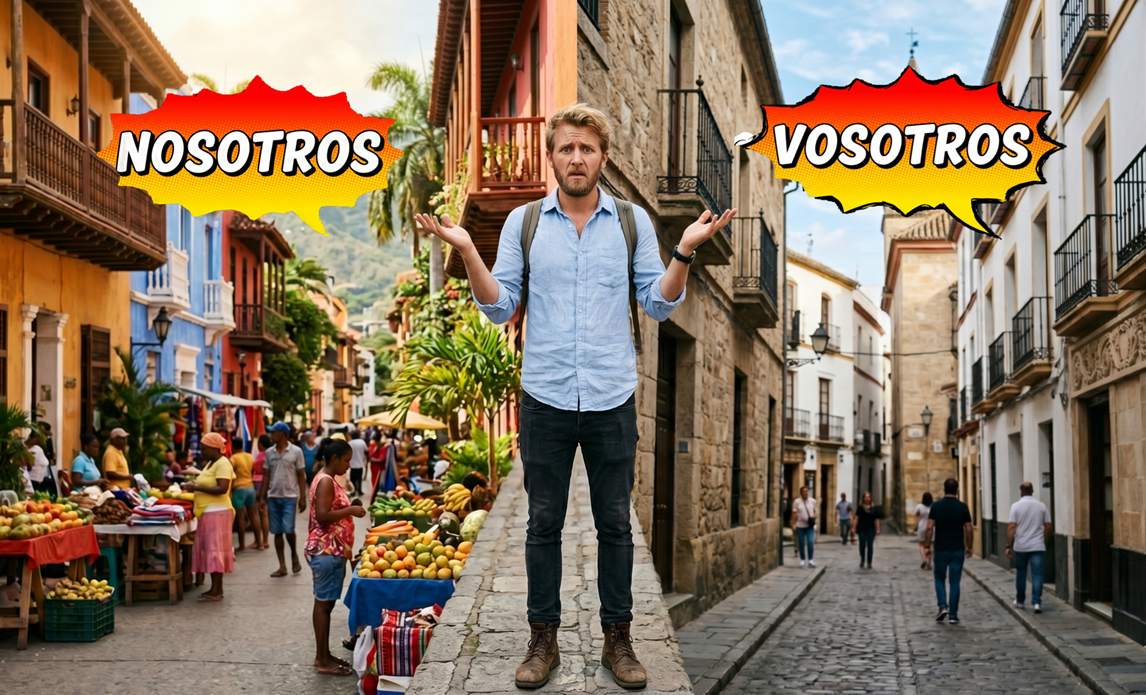
In Spain, when you talk to a group of friends, you say vosotros (you all, informal). It has its own verb conjugations, its own rules... it's a whole thing.
In Latin America, we just don't use it. At all. We say ustedes for everyone — friends, strangers, your boss, your abuela. It's simpler and honestly, one less thing to memorize!
So if you've seen vosotros in a textbook and panicked a little — relax. If your goal is to speak Latin American Spanish, you can skip it completely and focus on ustedes.
4. Accents across Latin America
Now here's something I love talking about: even within Latin America, every country has its own accent and personality. Mexican Spanish is super clear and widely understood — great for beginners. Colombian Spanish (especially from Bogotá) is often called one of the easiest accents to understand. Argentine Spanish has that beautiful Italian-influenced melody to it.
The point is, once you build a solid foundation, all these accents become recognizable and even exciting rather than confusing.
So which Spanish should YOU learn?
Here's my honest advice as a teacher:
If you want to travel through Latin America, work with Latin American colleagues, or connect with Latin American friends and family — learn Latin American Spanish. It's what we teach, it's what we speak, and it's understood by over 400 million people.
If you're specifically going to Spain or working in a Spanish context — then Spain Spanish makes more sense for you.
And if you're just starting out and not sure yet? Go with Latin American Spanish. It's a great foundation, the pronunciation feels natural for English speakers, and you'll be understood everywhere.
The bottom line
Don't stress about "which Spanish is better." They're both beautiful, both valid, and once you reach a good level of fluency, understanding both is much easier than you think.
The most important thing is to start speaking — and to practice with real native speakers who can help you sound natural, not just textbook-correct.
That's exactly what we do at Spanish Now. 😊
Want to practice your Spanish with a native Latin American tutor?Book a free intro call — I'd love to meet you and help you figure out where to go from here.
